Bridging the gap between search and citation
The search landscape is undergoing a fundamental shift as traditional search engines integrate generative capabilities. Organizations now face the "citation gap": the risk of AI models answering user queries without attributing the source.
Magnolia DXP provides the foundation for a twin-track strategy, making your content discoverable for people and indexable for Large Language Models (LLMs), while a measurement layer tracks your brand’s visibility across ChatGPT, Perplexity, and Gemini for continuous, data-driven optimization.
Content semantics and governance
Successful Generative Engine Optimization (GEO) begins with content that is architected for clarity and verified for accuracy to earn AI citations and maintain Expertise, Experience, Authoritativeness, and Trustworthiness (E-E-A-T).

AI-ready, atomic content structure
Flat HTML makes it hard for AI to find what it needs. The Magnolia Stories App breaks content down into granular "atoms" — headlines, blurbs, and fact boxes. By structuring data this way, we make it effortless for LLMs to cite your brand as the definitive source.

Enterprise-grade governance
AI models prioritize content freshness and authority. Magnolia DXP’s versioning and four-eye approval workflows ensure that only verified, high-quality facts reach AI crawlers, proactively mitigating the spread of misinformation.

Grounded in your expertise
Using Retrieval-Augmented Generation (RAG), Magnolia DXP ensures that summaries and Q&A snippets are drawn exclusively from your vetted internal knowledge base. This is designed to minimize AI "hallucinations" by anchoring every output to your specific business context.

Optimization for generative discovery
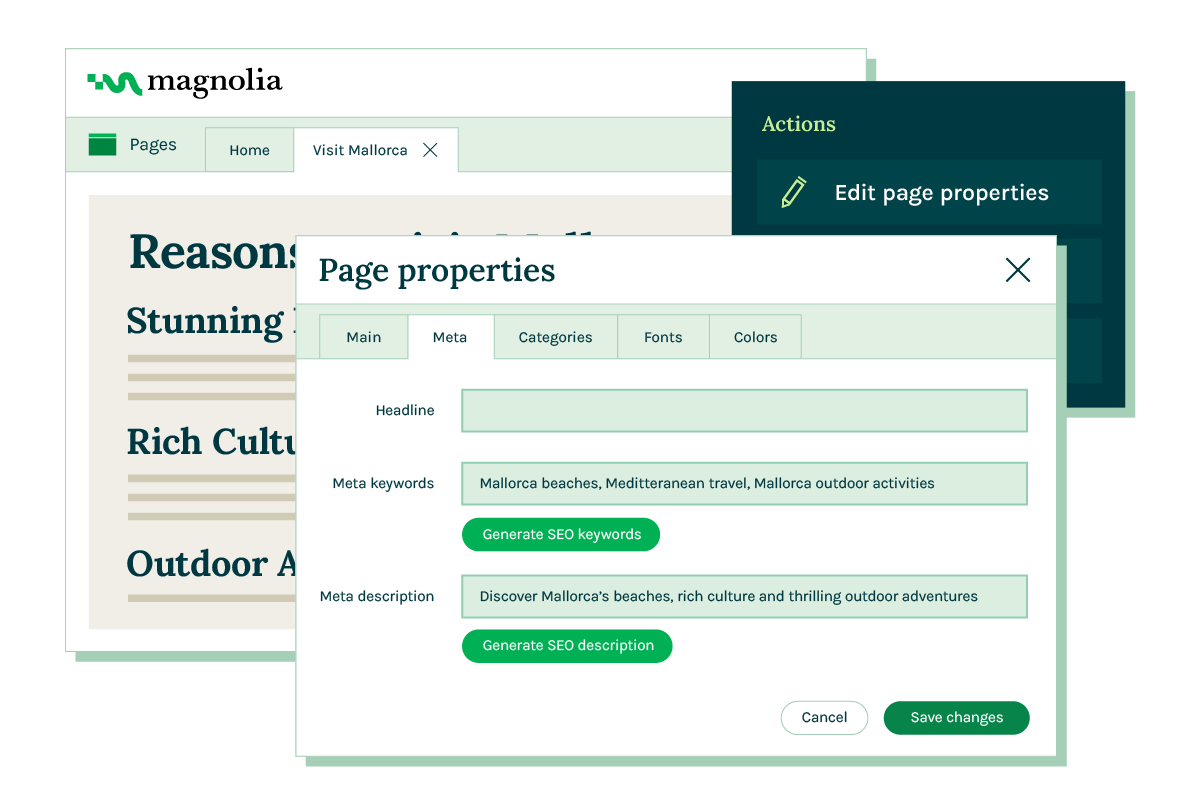
Magnolia DXP measures your generative search share-of-voice across ChatGPT, Gemini, Claude, and Perplexity. By combining LLM audits with technical agent readiness checks, you can optimize your content and eliminate barriers to AI discovery.
Technical and architectural foundation
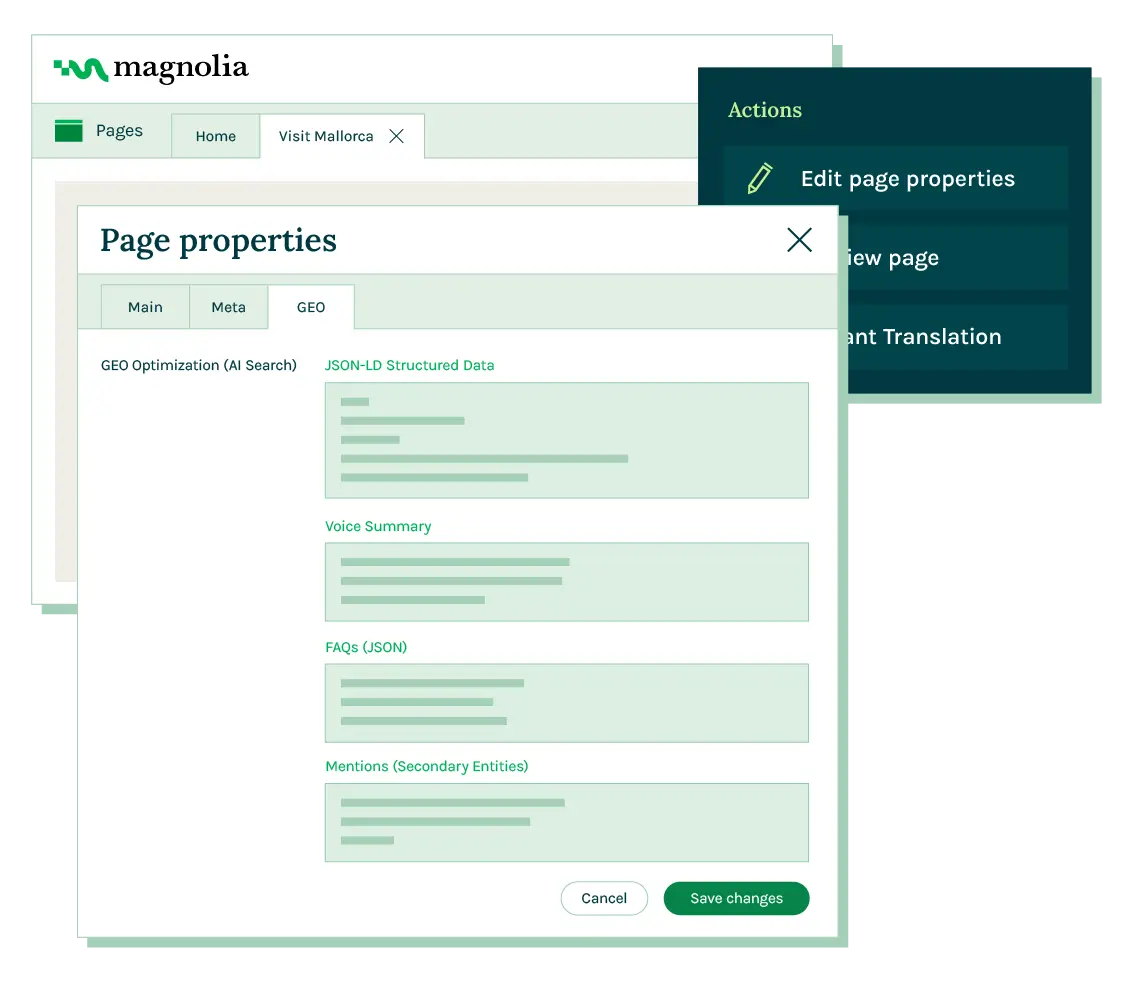
To remain visible in a generative environment, your infrastructure must support machine readability without compromising on-page performance. Magnolia DXP centralizes these technical requirements directly within the authoring interface.
- Hybrid headless delivery: Simultaneously serve static HTML for speed (Core Web Vitals) and clean JSON endpoints for LLM ingestion.
- Server-Side Rendering (SSR): Solves crawlability issues for Single Page Applications (SPAs) by providing search bots with fully populated HTML.
- Automated JSON-LD and structured data: Use AI to generate Schema.org markup (FAQ, Product, Organization) to supply ground-truth facts directly to AI models.
- Integrated content intelligence: Embed your analytics tool of choice into the authoring UI to validate SEO, accessibility, and content health via real-time widgets and automated prepublish quality gates.
- AI discoverability reporting: Monitor how your brand appears across generative AI surfaces with reports on citations, keyword visibility, and overall AI footprint.
- Agent readiness assessment: Check whether your content and site structure meet the needs of autonomous AI agents, with clear gaps and recommended fixes.
Twin-track optimization playbook
You can begin implementing this visibility framework immediately within the Magnolia DXP environment to scale digital operations without technical debt.
- Componentize guides: Break long-form content into reusable sections within the Stories App for cleaner crawls and richer sitelinks.
- Layer structured data: Utilize YAML configurations to add Article, Product, and FAQ schema to supply ground-truth facts to AI models.
- Deploy summary blocks: Use the AI Accelerator to create 100-word summaries that LLMs can easily cite in conversational results.
- Analyze conversational intent: Use support logs and internal search data to align content with natural language queries used in AI interfaces.
- Audit visibility: Use Magnolia's AI discoverability reports to track how your brand appears across generative search — monitoring citations, keyword coverage, and competitors.
A Q&A with AI experts
Is your content ready for GEO?
The age of generic content is over. As AI models like Google's AI Overviews take over search results, the game has changed from matching keywords to owning concepts and answering questions with unique authority.
Watch our SEO & GEO experts answer all your questions about GEO and AI search:
- AI search trends
- GEO’s technical foundations
- Semantic content engineering
- The human factor that makes content trustworthy, distinctive, and cited by AI
Product Tour
Take an interactive tour of Magnolia DXP GEO
Checklist
How to prepare your content for GEO
Master the shift from search rankings to AI answers with our GEO blueprint, ensuring your brand remains the cited authority for AI agents.

Learn more on Magnolia DXP GEO




Magnolia DXP GEO
Get in touch to assess your GEO readiness
To learn more about your current search health and how to move forward with a twin-track strategy, please reach out to our team.