- Aug 19, 2026
- --
Why banks must overcome customer barriers to generative AI
-
 Nora NowackSenior Product Marketing Manager, Magnolia


Experience Magnolia in action
Experience Magnolia's key features firsthand in an interactive product tour.
Take a tour nowKey insights
-
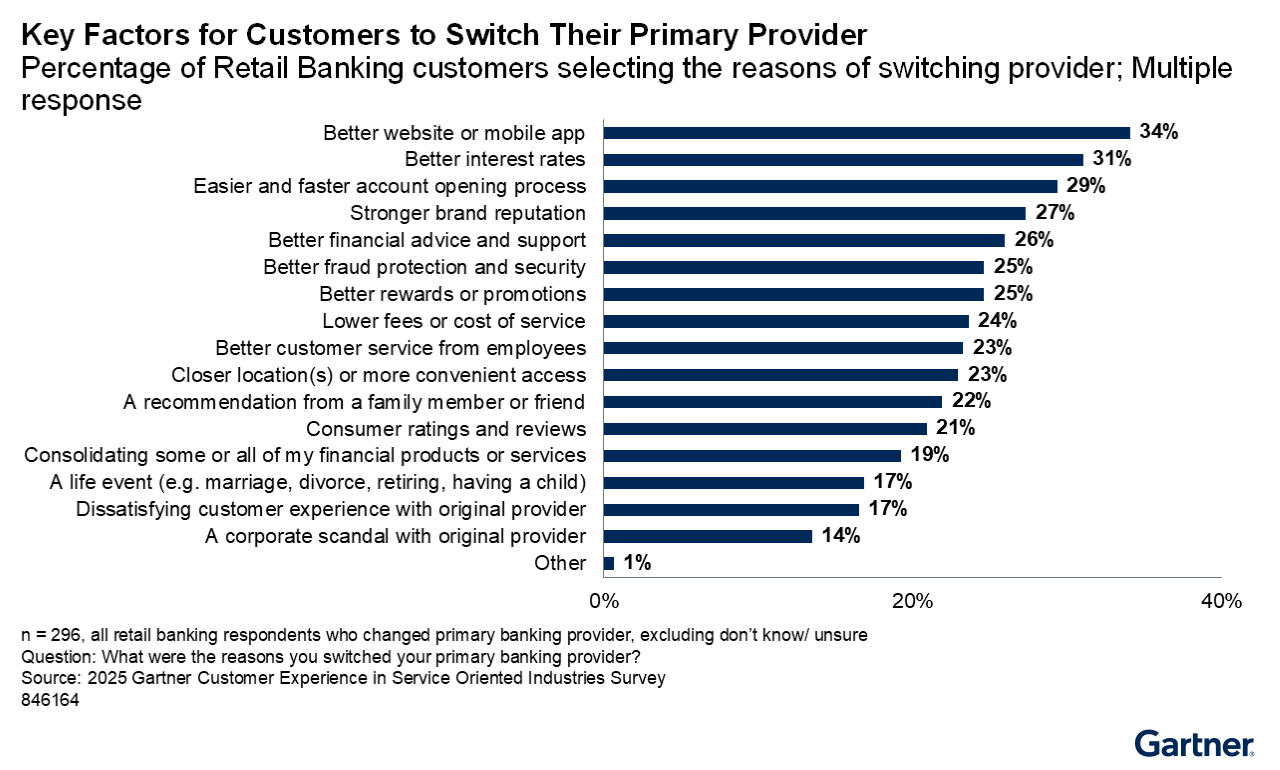
Digital customer experience serves as the primary catalyst for user retention, where “34% of retail banking customers switch providers for better website or mobile apps” is the top reason they change their primary bank.
-
Customer willingness to utilize artificial intelligence remains highly divided, meaning a uniform rollout risks alienating substantial parts of your consumer base.
-
Successful digital personalization acts as a prerequisite for future technology adoption, making customers 5.14 times more willing to interact with intelligent tools if the institution already customizes experiences extremely well.
-
Strengthening core data infrastructure, governance, and real-time decisioning resolves current application vulnerabilities while establishing readiness for subsequent automation layers.
Why banks must solve customer barriers to generative AI adoption
Digital customer experience in banking represents the entire journey of user interactions across web portals, mobile platforms, and self-service applications. To retain consumer loyalty, financial organizations must prioritize this experience layer over basic transaction processing. Gartner® research indicates that customer experience directly dictates retention, as an improper digital experience acts as the primary driver for customer churn. Instead of rushing to implement customer-facing artificial intelligence (AI) as a standalone remedy, enterprise leaders must first focus on resolving foundational infrastructure and data-path constraints.
Understanding customer polarization and retention trends
The modern financial sector shows that user expectations have outpaced the ability of teams to deliver clear digital clarity. This reality creates specific structural shifts that your organization needs to monitor:
Consumers switch their primary institutions primarily to secure a superior mobile application or website experience (34%), outranking other competitive factors like better interest rates (31%) or lower fees (24%).
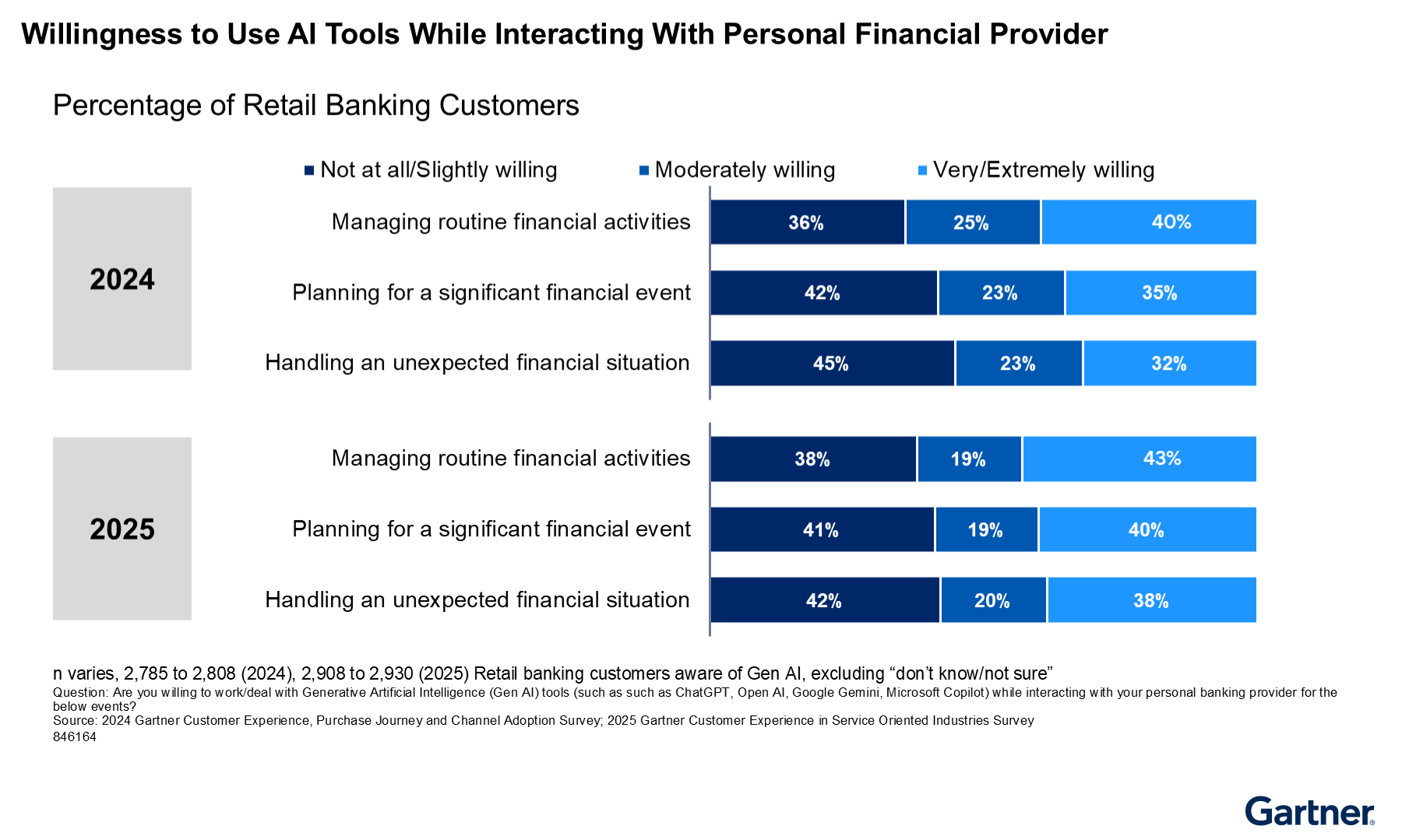
User willingness to accept generative artificial intelligence (GenAI) features is not uniform, as a distinct divide has opened between enthusiastic adopters and resistant customer groups.
The percentage of undecided consumers has fallen significantly, with the proportion of slightly or moderately willing customers dropping by more than half between 2024 and 2025.
Approximately 42% of banking customers report that their primary financial institution fails to actively educate them about their financial options, in our view, exposing a severe structural guidance gap.
Maximize your architecture potential
Learn how AI is revolutionizing content management and digital experiences to maximize your platform's efficiency.
Read the guideBuilding the data architecture for real-time engagement
To support modern application layers and future generative AI integrations, your technology stack must transition away from rigid, siloed operations toward automated, real-time decisioning. This requires moving beyond traditional content management systems to an integrated Digital Experience Platform (DXP) that serves as an agile orchestration layer.
Technical teams must address several architectural requirements to establish a reliable data path:
Designing a customer data layer allows web platforms to evaluate and execute the best course of action during active user sessions without manual processing delays.
Unifying authoritative data assets eliminates human intervention or manual data cleanup, ensuring that automated systems read clean, machine-actionable information on demand.
Implementing event-driven integration patterns prevents clunky user journeys during high-friction events like fraud alerts, overdraft notifications, or sudden interest rate shifts.
Embedding privacy controls, user consent tracking, and explainability mechanisms directly within the transaction execution path guarantees that safety operates during the interaction rather than as a post-processing checklist.
As noted by Gartner analysts Jonathan Jackson, Van To, and Sophia Palmstedt in the research report:
"Given customer polarization, leaders should focus on resolving the technical barriers that prevent adoption of customer-facing GenAI, even if they don't plan to implement customer-facing GenAI anytime soon."


Navigating market segmentation and European data standards
For financial groups operating within the European and DACH regions, addressing these technical vulnerabilities matches strict regulatory standards like data privacy and governance mandates. Deploying automated features without clear architectural planning introduces major compliance risks, making strategic segmentation crucial. Targeting initial deployment toward young and affluent consumer segments minimizes risk because these groups display the highest structural openness to digital innovation.
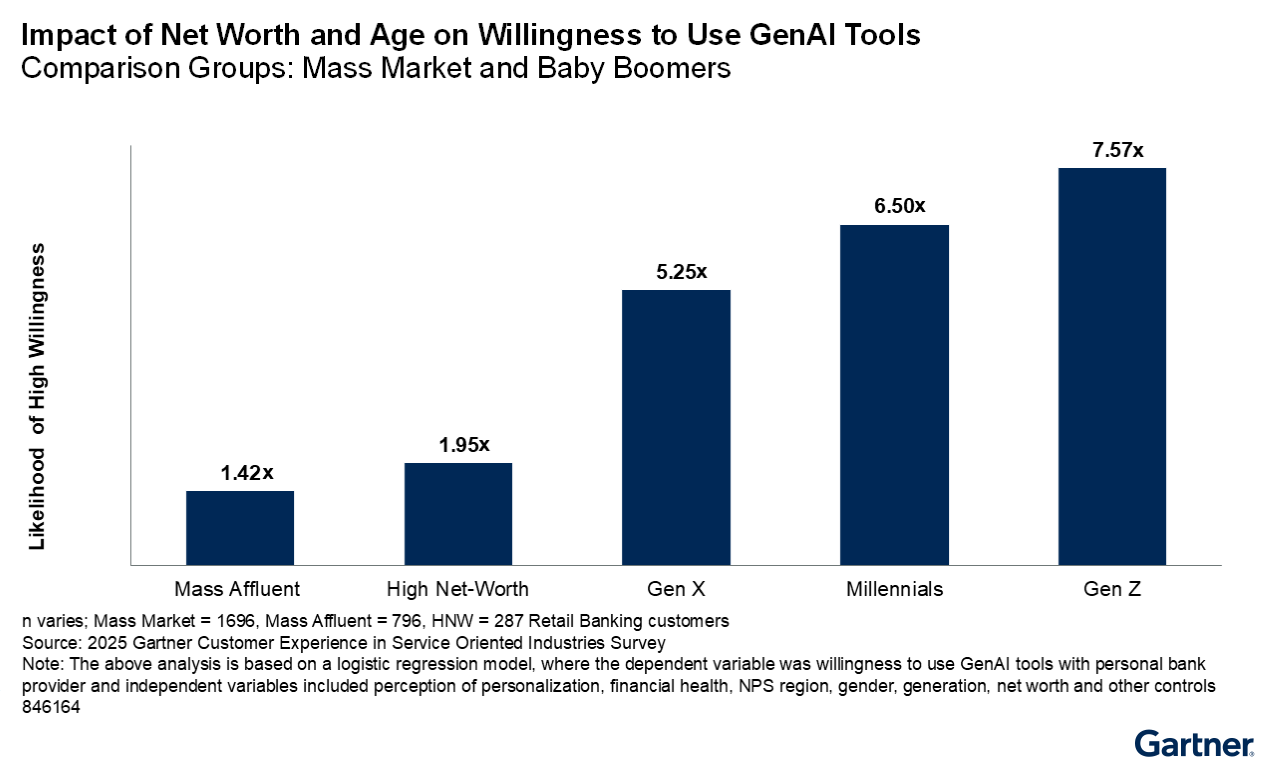
Gartner data evaluates that age and wealth are the most significant statistical indicators of user acceptance:
Gen Z consumers are 7.57 times more likely to demonstrate high willingness to use AI tools compared to baby boomers.
Millennials show a 6.50 times higher likelihood of embracing automated tools relative to older demographics.
High-net-worth (HNW) individuals are 95% more likely to adopt automated financial tools than mass-market retail banking consumers.
Mass-affluent clients exhibit a 42% higher likelihood of adopting these automated tools compared to standard retail consumer baselines.
To preserve trust across your broader client base, enterprise applications must always offer clear transparency regarding data usage and explicit options to opt out of automated systems completely. This transparent approach turns data governance from a pure compliance check into an active method for maintaining long-term consumer relationships
Preparing your digital foundation with Magnolia DXP
Modernizing your experience layer does not require a risky, full replacement of legacy core transaction systems. Magnolia DXP provides a modular, composable architecture that separates content delivery from rigid backend code using flexible Application Programming Interfaces (APIs). By acting as a central orchestration station, our platform integrates existing customer databases and analytics engines directly into a visual authoring environment. This composable approach allows your teams to execute hyper-personalized user journeys and deploy agile microservices incrementally, lowering your total cost of ownership without introducing technical debt. Strengthening this underlying digital infrastructure solves your immediate retention challenges while ensuring your platform stands ready for any future AI capabilities your consumers choose to adopt.
Download the complete Gartner report on banking customer AI adoption
Get immediate access to the full strategic research by Jonathan Jackson, Van To, and Sophia Palmstedt. Learn how we feel you can audit your data architecture, handle user polarization, and execute a compliance-first digital roadmap that secures long-term retail banking retention.
Read the complete Gartner reportFAQs
Gartner Inc., Why Banks Must Solve Barriers to Customer Adoption of Generative AI, Whether Banks Deploy It or Not, Jonathan Jackson, Van To, Sophia Palmstedt, 2 March 2026. Gartner is a trademark of Gartner, Inc. and/or its affiliates. Gartner does not endorse any company, vendor, product or service depicted in its publications, and does not advise technology users to select only those vendors with the highest ratings or other designation. Gartner publications consist of the opinions of Gartner’s business and technology insights organization and should not be construed as statements of fact. Gartner disclaims all warranties, expressed or implied, with respect to this publication, including any warranties of merchantability or fitness for a particular purpose.
*This graphic was published by Gartner, Inc. as part of a larger research document and should be evaluated in the context of the entire document. The Gartner document is available upon request from our analyst reports.