- Oct 14, 2026
- --
How Infosys automates AEM to Magnolia DXP migrations
-
 Nagarajan KuppuswamyPrincipal Technology Architect, Infosys
Experience Magnolia in action
Experience Magnolia's key features firsthand in an interactive product tour.
Take a tour nowKey insights
-
Strategic Shift to Composable DXP: Large enterprises are migrating from tightly coupled, capability-heavy platform architectures, such as Adobe Experience Manager (AEM), to Magnolia DXP to reduce total cost of ownership (TCO) and avoid paying for unused capabilities.
-
AI-Powered Migration Velocity: The Infosys CMS Automigrator is an AI-driven accelerator that converts manual migration workflows into automated sequences, enabling migration of 300–400 pages per day and reducing person-days of effort by 50%.
-
Data Loss Prevention: The accelerator employs a "rich text fallback strategy" and AI-driven schema mapping to ensure content is successfully migrated to Magnolia DXP even when target components or structures lack direct equivalents in the source CMS.
-
Component Consolidation & Cleanup: The migration process streamlines digital operations by consolidating hundreds of legacy components (down to 65-70) and using AI to automatically clean naming conventions, handle unsupported characters, and identify corrupted assets.
-
Architectural Best Practices for Performance: Ensuring optimal post-migration performance on Magnolia DXP requires proactive digital asset management (DAM) taxonomy restructuring (with under 500 assets per folder) and separating product data via dedicated PIM integrations rather than local CMS storage.
Why enterprise organizations move from legacy AEM to composable DXP
Enterprise organizations are migrating away from platforms like Adobe Experience Manager (AEM) primarily because the total cost of ownership no longer justifies the value they actually receive. Platforms like Magnolia DXP offer a composable, cost-efficient alternative that preserves flexibility without forcing companies to pay for capabilities they will never activate.
Nagarajan Kuppuswamy, Principal Technology Architect at Infosys, frames the decision in concrete terms:
"Now a product like Adobe or Sitecore can offer you 50 different capabilities, but in a normal day-to-day working — or even if you have to build your websites — what is the number of features you're going to use? That may not be all the 50. Companies have started realizing the value-for-money proposition: where do I really need a 1,000 cc bike, or can I be done with a 500 cc bike?"


Beyond licensing costs, structural problems drive enterprises toward migration. Many large organizations accumulate multiple CMS installations across regions and business units — AEM in one market, Drupal in another, FirstSpirit (CrownPeak) in a third — creating fragmented content operations that are expensive and difficult to maintain. The siloed digital asset management (DAM) that accompanies this fragmentation compounds the cost.
Magnolia DXP addresses these structural challenges through its composable architecture. The platform delivers a lower total cost of ownership, enterprise-grade Java support, strong headless support for content delivery to any channel, native DAM capabilities, and deep integration with third-party tools via APIs — including CDP, personalization, and commerce platforms. Infosys is a global systems integrator partner for Magnolia DXP, enabling it to deploy and configure the platform at enterprise scale across all of these dimensions.
The result: organizations paying a premium for legacy platforms can consolidate onto Magnolia DXP and redirect budget toward composable integrations that actually match their use cases.
The biggest fears and pitfalls holding enterprises back from CMS migration
Enterprise organizations recognize the pain of their legacy CMS — but fear the pain of migration even more. Three concerns consistently surface: will content be lost, how long will it take, and what will it cost to fix what breaks along the way.
Does migrating off AEM lead to content loss? Using the rich text fallback strategy
The risk of content loss is real but manageable. The rich text fallback strategy is a data preservation approach that ensures no content is discarded during migration, even when the source content type has no direct equivalent in the target CMS.
When a content type defined in the source system has no identical equivalent in Magnolia DXP, the Infosys CMS Automigrator falls back to mapping that content into a rich text field, preserving it intact for later reuse or repurposing by the content team. As Nagarajan Kuppuswamy explains:
"We also have an approach where the customer does not know what to do with the content for now, but they don't want to lose the content. In such cases what we do is we define a rich text field kind of attribute and we dump the content there so that the content can be reused or repurposed later once the migration is done."
The AI layer of the accelerator further reduces data loss risk by suggesting the nearest-fit content type mapping when an exact match is unavailable, so that even edge-case content lands somewhere meaningful rather than being dropped.
How do incompatible taxonomies and PIM data derail CMS migrations?
Two technical pitfalls account for a disproportionate share of migration failures: poorly defined asset taxonomies and conflating product data with CMS content.
Magnolia DXP's best-practice limit is fewer than 500 assets per folder. When source taxonomies group tens of thousands of assets into a single folder, performance degrades sharply after migration — authors experience slow load times and perceive the migration as a failure, even though the content arrived intact. Taxonomy must be redefined and validated before a single asset moves.
The second pitfall is using CMS as a Product Information Management (PIM) system. Magnolia DXP integrates with third-party PIM systems via APIs — that is the correct architectural pattern. CMS is designed to hold marketing content and static assets; product catalog data belongs in a dedicated PIM, exposed back to Magnolia DXP through APIs. Migrating PIM data wholesale into Magnolia DXP is a sure path to performance problems and post-migration rework.
How long does an AEM to Magnolia DXP migration typically take?
Without tooling, a migration of significant scale can stretch across years. With the Infosys CMS Automigrator, the same migration compresses into months or weeks depending on whether the CMS is already onboarded into the migrator or not. The specific timeline depends on content volume, source system complexity, and the degree of component consolidation required — but the order-of-magnitude difference between manual and automated migration is consistent across engagements.
How the Infosys CMS Automigrator works: An end-to-end approach
The Infosys CMS Automigrator is an AI-powered end-to-end migration accelerator that automates the full lifecycle of website migration — from asset extraction through content transformation, code migration, and automated page authoring — without requiring manual re-authoring of individual pages. The Infosys CMS Automigrator automates migrations from AEM to Magnolia DXP, covering all interdependent steps that traditional migration scripts address only in isolation.
Compare Magnolia DXP to AEM
Get the functionality you expect at a fraction of the cost. This comparison highlights feature parity and how you can simplify your stack without losing capability.
Read the full comparisonCollaborating on the mapping sheet to align schemas
A mapping sheet is a schema-alignment document that defines how each content type, field, and asset in the source CMS maps to its nearest equivalent in Magnolia DXP. It is the primary input to the Infosys CMS Automigrator — if the mapping sheet is incomplete or incorrect, the accelerator cannot produce a clean migration.
The mapping process is collaborative by design. The Infosys team works directly with business users and content owners to review every content-type mismatch, explain the trade-offs among available Magnolia DXP equivalents, and obtain sign-off on the chosen approach before any automated run begins. "As I keep telling Ravi and the team, we want to remove the word 'manual' from our vocabulary. We first create a mapping sheet, which is the input to the accelerator. If the mapping sheet is not right, the accelerator cannot work properly," said Nagarajan Kuppuswamy. This consultative step is what enables the automation to run reliably and without surprises.
The four-phase migration sequence: Assets, content, code, and page authoring
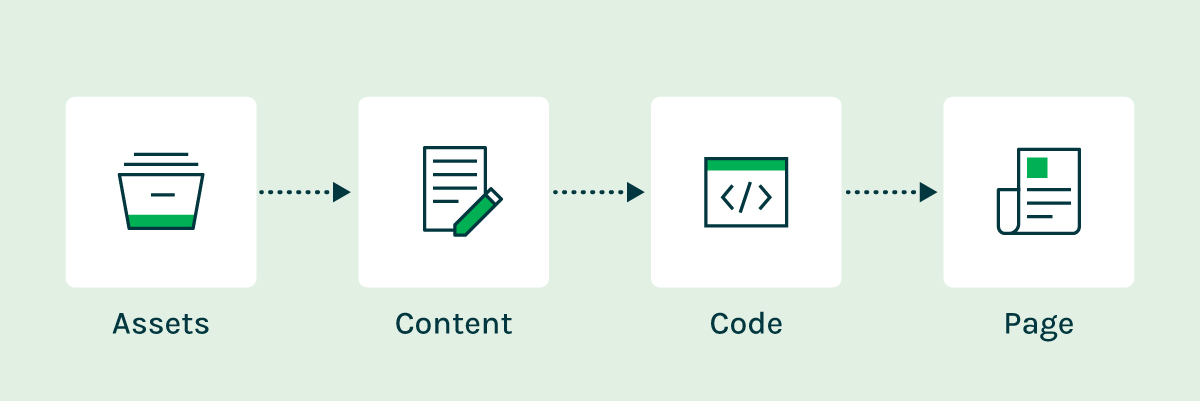
The migration follows a strict sequence: assets first, then content, then code, and finally page authoring. The order is not arbitrary — each phase creates dependencies the next phase relies on.
Assets migrate first because taxonomy changes produce new URLs, and those new URLs must be embedded into content before content migration begins. The accelerator maintains a staging repository of all migrated asset references so the content migration phase can perform automated URL replacement within content item.
Content migration follows, applying template-to-content mapping and performing media replacement so that images, PDFs, and linked assets point to their new destinations. Code migration then handles template layouts and component definitions. Finally, page authoring is automated based on how pages were structured in the source system — components, content assignments, and publish states are replicated in Magnolia DXP without manual re-authoring.
How AI powers the transformation engine
Traditional migration scripts are deterministic and point-to-point — built for one source CMS and one destination, they cannot be reused across engagements without significant rewriting. The Infosys CMS Automigrator uses AI to generalize the transformation engine so that any source CMS can be onboarded with minimal configuration change.
The AI layer performs several validation and sanitization functions across every migration run:
Naming convention repair: Asset and content names containing unsupported special characters are detected and corrected automatically. For example, translating special characters into standardized Latin.
Corrupted asset detection: Zero-kilobyte and corrupted assets are identified in bulk before migration, with a consolidated report flagging exactly which assets failed and why.
Corrective feedback loop: The system generates a post-run summary of every anomaly, enabling the team to improve the next batch rather than discovering problems during manual QA.
The AI's role is to make the process faster and more reliable — not to lower the quality bar. As Ravi puts it:
"AI is to kind of make things simpler, faster, and better. AI does not give the liberty to anyone to do a substandard implementation."

Best practices for Magnolia DXP must still be followed in full.
Consolidating 250-300 components down to 65-70 through transformation
Enterprise AEM installations accumulate components over years of development, often resulting in hundreds of overlapping or redundant definitions. The Infosys CMS Automigrator handles component consolidation as part of the transformation layer — splitting components that need to be decomposed, merging components that serve the same function, and restructuring the result to align with Magnolia DXP best practices.
This consolidation reduces ongoing maintenance burden and simplifies authoring in the target Magnolia DXP instance — directly supporting the ease-of-use and TCO benefits that motivated the migration.
Preparing authors for the post-migration DXP experience
Migrating content successfully is only half of the challenge. Content authors who have spent years in AEM need structured training on Magnolia DXP before they can operate effectively in the new environment — and that training must be grounded in the structural changes the migration actually introduced.
For example, the agrochemical engagement involved migrating FirstSpirit "entities" — a data type with no equivalent in Magnolia DXP — into Magnolia DXP content apps, then exposing them as headless APIs for the website to consume. Authors who worked with entities in FirstSpirit need a clear explanation of where that data now lives and how to manage it going forward.
Best practices cannot be retrofitted after go-live. If Magnolia DXP is handed over with incorrect taxonomy — for example, a folder containing tens of thousands of assets — the performance degradation authors experience will read as a product failure rather than a configuration error. Training and best-practice governance must therefore begin during the migration engagement, not after handover.
What to consider before starting your migration journey
An AEM-to-Magnolia DXP migration succeeds or fails during the preparation phase, before a single asset is moved. The initial evaluation must address four dimensions.
Content and asset volume. Understand the total scope: number of websites, pages per site, total content items, and total asset size. The agrochemical engagement involves 125 websites, approximately 30,000 pages, and 3.5 terabytes of assets — knowing these numbers up front determines resourcing, tooling configuration, and the timeline.
Data modeling and taxonomy. Confirm that the source taxonomy can be restructured to meet Magnolia DXP best practices (fewer than 500 assets per folder) before migration begins. Define how every source content type maps to Magnolia DXP equivalents and surface mismatches early, so they are resolved in the mapping sheet rather than discovered mid-run.
Tech stack dependencies. Identify all applications that consume content or assets from the source CMS via APIs — mobile apps, external portals, and personalization engines. Each dependency must be remapped to the corresponding Magnolia DXP API before the consuming application is switched over.
CMS versus non-CMS data. Explicitly identify any data currently stored in AEM that does not belong in a CMS — product catalog data, analytics data, or other system-of-record content. Plan to migrate that data to the appropriate system (PIM, analytics platform) and expose it to Magnolia DXP via API, rather than importing it into the new CMS.
When evaluating your next CMS contract cycle
Many AEM license agreements carry multi-year renewal terms. Organizations approaching a renewal decision have a defined window in which migration is most financially advantageous — before the next contract locks in another cycle of elevated licensing cost. Infosys's delivery record on a 125-website, 30,000-page migration, combined with Magnolia DXP's licensing model and composable architecture, means organizations can realistically complete a migration and demonstrate ROI within a single contract cycle.
As a global systems integrator and Magnolia DXP partner, Infosys brings both the tooling and the enterprise delivery experience to execute migrations at scale. Organizations that have already built on AEM, Drupal, or FirstSpirit can begin with the Infosys CMS Automigrator in its current configuration — Infosys does not rebuild the accelerator for each new client engagement. Configuration changes are sufficient to accommodate new source system customizations.
For more on how Magnolia DXP enables composable digital experiences, see Magnolia DXP features overview, pricing and licensing, customer stories, and composable DXP architecture.
Book a Magnolia DXP Migration Strategy Consultation
Get a personalized assessment of your AEM migration scope, timeline, and automation opportunities from the Infosys and Magnolia DXP team.
Book your consultationAdobe, Adobe Experience Manager, and AEM are trademarks of Adobe Inc. Sitecore is a trademark of Sitecore Corporation A/S. Drupal is a trademark of Dries Buytaert. Magnolia DXP is not affiliated with, sponsored by, or endorsed by Adobe, Sitecore, or the Drupal project.