- Feb. 27, 2026
- --
How to improve your customers’ digital experience with generative AI
-
 Sorina MoneHead of Marketing, Magnolia
 -
 Jan SchulteHead of Group Consulting, Magnolia



Magnolia in Aktion
Unser Expertenteam zeigt Ihnen live, was Magnolia für Sie leisten kann.
Jetzt Demo buchenKey insights
- Magnolia CMS accelerates content production by embedding best-in-class generative AI tools directly into your editorial workflow.
- Knowing how to choose a marketing solution with embedded generative AI ensures you can scale content creation without sacrificing brand consistency or compliance.
- Effective use of generative AI in CCM & CXMstrategies requires the right mix of text, image, and translation tools.
- Magnolia CMS offers a composable architecture, allowing teams to swap AI models as technology evolves, future-proofing your digital strategy.
Meeting the demand for persona-based content can be challenging for content production teams, and it seems like artificial intelligence (AI) is the answer to that problem. At Magnolia, we’ve been working on making AI real for content teams, and with the release of our AI Accelerator, we’ve come to a solution that empowers editors to increase the speed and scale of content creation using proven generative AI tools of their choice - without leaving the editorial interface and the workflow they’re used to with Magnolia.
But with so many generative AI tools to choose from, it can be a struggle to decide how to choose a marketing solution with embedded generative AI that is right for you.
We give you a better understanding of the types of generative AI available to help you pick and look at the most popular tools across these three categories:
Text generation, research, and analysis
Image generation and editing
Translation
We also discuss use case scenarios (including how we take advantage of some of these tools in Magnolia), potential legal or ethical concerns, and the role of AI detectors.
Ready? Then let’s dive in.
Understanding the role of artificial intelligence in content creation
Topics like natural language processing are so prevalent in headlines these days that it’s difficult to grasp each AI model’s specific implications. Before we proceed with different tools, let’s define what we mean by generative models in the context of marketing or content management.
With the exception of virtual assistants and productivity tools, you’ll mostly encounter examples of generative AI in the marketing world, rather than a general-purpose neural network. When we speak of “generative AI models,” , especially when discussing generative AI in customer communication management and customer experience management (CCM & CXM) contexts, we refer to the machine learning model’s capability to create new content, so it’s often used to differentiate a model with a narrow focus from a general-purpose AI system.
To effectively use generative AI models, understanding the data science behind them is key. Without this, comparing and evaluating options becomes difficult.
Many companies promote their synthetic data preprocessing or their token count, recognizing their impact on result quality. Additionally, for a large language model (LLM) to make sense of its training data, engineers normalize and encode the information for the algorithm. That means, limited datasets and faulty data cleaning lead to inaccurate output or a discriminative AI algorithm.
Equally, each generative AI application’s tokens will determine the use cases it can handle. For example, GPT-5.1 has token limits, but these limits vary significantly depending on whether you are using it through ChatGPT (Free - 16,000 tokens - , Plus, Pro) or the API (for developers - 400,000 tokens - ). Another language model may have varying token limits or try to make up for them through integrated web access to include new data.
In the absence of information shared by service providers, tests like the ROUGE or BLEU score offer metrics for AI-translated or -summarized text.
Whichever tool you choose, you should always consider the ethical and legal implications of embedding them in your marketing strategies. Using generative AI models necessitates sharing at least some details, and entering confidential company information could impact your contractual obligations.
That said, integrating a generative model into your content management efforts allows for streamlined content production and can save precious resources.
Making generative AI real for content teams
Learn how to produce better content faster with AI.
Download the white paperPicking the right AI tool for text generation
Given the abundance of tools and features, it's impossible to suggest one AI tool for your copy needs. We'll ease into it by presenting use case scenarios, followed by tool recommendations.
Draft marketing copy: While applications will differ in their user interface (UI) and output, most can be used to generate headlines, meta descriptions, alt texts, or fleshed-out blog and landing page copy.
Summarize videos or website data: Generative AI tools like ChatGPT and Copy.ai scrape publicly available data to enhance their text-generation capabilities. You could use those to summarize a podcast’s talking points or draft a TLDR for a blog post.
Develop content briefs and outlines: Some applications offer templates aimed at marketing teams, whereas others require you to prompt the language models to deliver one, either based on your company profile or competitors’ branding choices.
Brainstorm ideas: Every marketer has gone through a creative block. Especially in remote teams where a colleague is not always available, bouncing ideas off AI technology can be a great starting point.
Repurpose copy for social media: Simply feed your blog copy into generative AI algorithms and ask for a LinkedIn post or Instagram caption based on your content.
Analyze competitors: Whether you’re analyzing a competitor’s word choices in headlines, their use of technical jargon, or their entire stylistic preferences, a machine learning model makes en-mass analysis easy.
The natural language solutions we’re about to discuss will yield varied outcomes within different UIs. To speed up supervised learning, content generation, and optimization at scale, a composable digital experience platform (DXP) like Magnolia can offer a combination of tools in a unified UI and editorial workflow. When assessing generative AI technology, keep in mind that while some of them integrate with DXPes and bring more flexibility, others don't.
ChatGPT (OpenAI) - Best for: Creative writing; Key feature: Uses the GPT-5.1 model which excels at deep reasoning ("Thinking Mode") and handling massive amounts of context.
Claude (Anthropic) - Best for: Writing geared towards a natural, human-like tone and processing large documents; Key feature: Known for having a highly "steerable" writing style that sounds less robotic than competitors. Models likely include Claude 4.5 Opus.
Google Gemini - Best for: Research and integrating with Google Workspace (Docs, Gmail, Drive); Key feature: Excellent at pulling real-time info from the web and citing sources.
Jasper (powered by OpenAI’s GPT-3.5 and GPT-4 models) - Best for: Enterprise marketing teams who need to maintain a specific brand voice; Key feature: You can upload your company’s style guide, and it ensures every email, blog, or ad sounds exactly like your brand.
Copy.ai - Best for: Quick, high-volume social media posts, ad captions, and email subject lines; Key feature: "Workflows" that can turn one blog post into 10 tweets, a LinkedIn post, and an email newsletter in one click.
Amazon Comprehend - Best for: An ideal solution for continuous research and project management, and an integral part of Magnolia’s text classification module, where you can use it to analyze and tag your text content for better searchability; Key feature: Ideal for marketers or customer support teams who have thousands of emails/reviews and need to know how people feel without reading them all.
Anyword - Best for: Performance marketing (Ads); Key feature: It gives you a "Predictive Performance Score" before you even publish, guessing how likely users are to click your ad based on historical data.
Writesonic - Best for: Creating SEO-optimized articles in seconds; Key feature: Has a trusted "Article Writer" mode that browses the live web to ensure factual accuracy before writing the post.
Surfer AI - Best for: Ranking existing content; Key feature: It doesn't just write; it analyzes the top 10 results on Google for your keyword and tells you exactly which words to use to beat them.
Grammarly - Moving beyond spell-check, it now uses AI to rewrite entire paragraphs for clarity, tone, and conciseness.
Wordtune - Excellent for "rewriting" specific sentences. If you are stuck on a clunky sentence, it offers 10 better ways to say the same thing.
In a nutshell, how can such text generation tools help in your day-to-day editorial work? Take a look at how we’ve integrated ChatGPT and Amazon Comprehend in Magnolia, to support the following use cases:
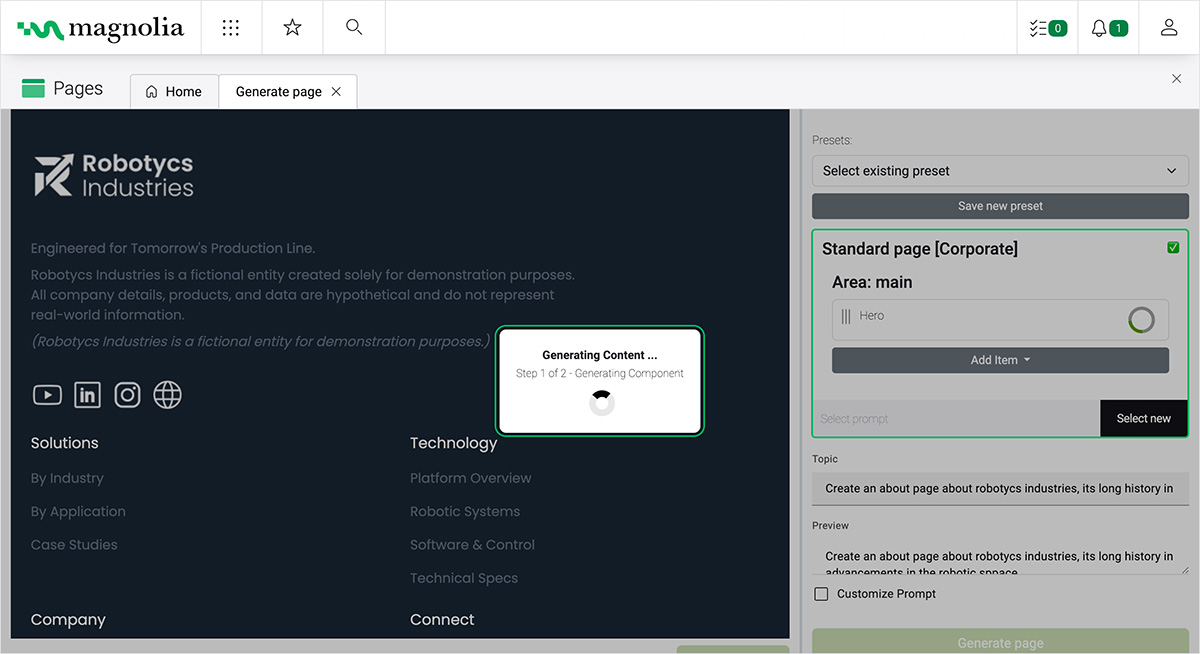
Automatic generation of components (text, images, or a combination of these) and even entire pages.
Automatic generation of component variants for personalization.
Automatic generation of metadata and image description (SEO and OG), to optimize content before you hit publish.
Automatic generation of image descriptions based on image tags.
Automatic tagging and text classification for better searchability.
Generative AI tools for images and logos
Image generation tools are confronted with some of the same challenges other AI models face, whether that’s legal considerations or the question of how much the procedure relies on prompting over templates. However, applications offering AI capabilities for image generation tend to struggle a bit more with delivering consistent branding across assets.
Nevertheless, they can be helpful in the content creation process because they fulfill different requirements than graphic designers. Sometimes, they can simply help a client convey a rough idea or fill in graphic patterns at a level of detail that wouldn’t be feasible to deliver for a human. Here are some tools to consider for your imagery needs:
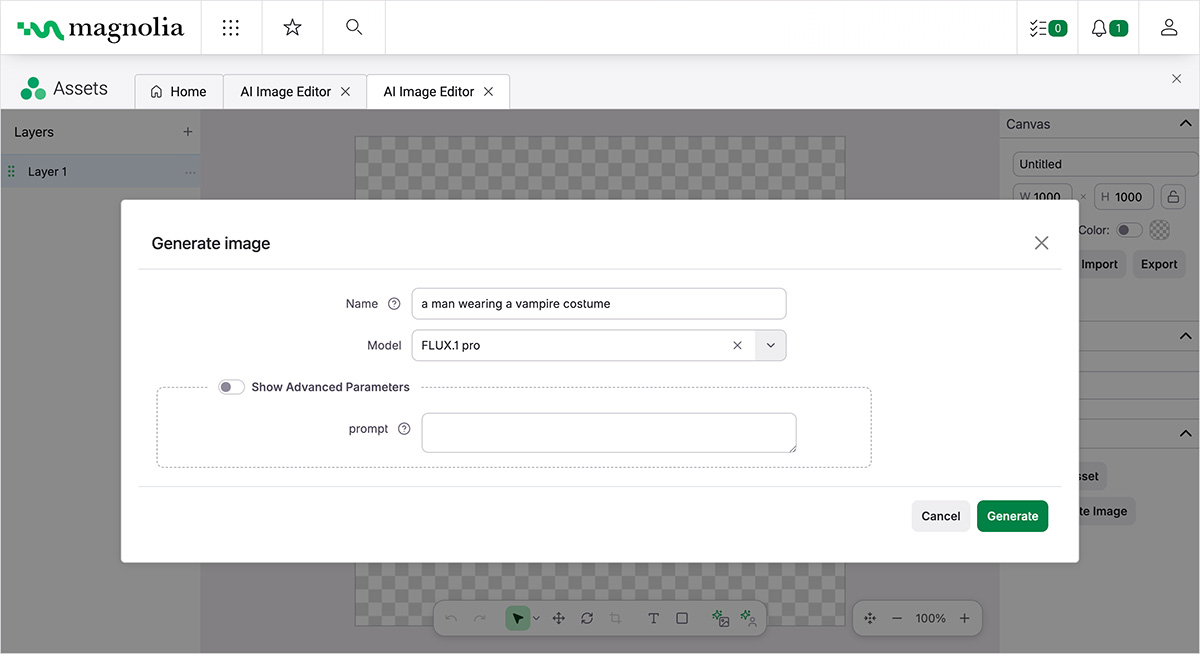
DALL-E: OpenAI’s AI model can help you generate visual content based on text prompts, which makes it a useful tool for product visualization, content ideation, and creation. Excellent at interpreting complex, nuanced instructions and rendering legible text within images. Integrated directly into ChatGPT for a seamless back-and-forth workflow. We’ve integrated DALL-E into our DXP so you can easily generate and edit images and directly save them in the Magnolia DAM.
Shutterstock: When the photo stock marketplace entered the AI realm, it addressed an issue totally unrelated to creativity or output, namely licensing. With their shift toward AI, Shutterstock introduced a Contributor Fund to compensate artists and an AI-specific license, which lets you use generated images on commercial pages.
Midjourney: Allows for extremely fast iteration and conversational prompting to refine images on the fly. Known for its distinct, high-quality artistic style.
Adobe Firefly: Built directly into Photoshop and Illustrator. It is trained on permissioned data, making it commercially safe for businesses concerned about copyright.
PhotoRoom: Free tools like PhotoRoom don’t try to impress you with endless features, but they do one thing incredibly well. In this case, you can easily remove backgrounds on your product pictures.
Runway and Playground: While Runway’s or PlayGround’s features may not be unique, they could make it easier for some users to get started through a limited number of choices. Where you would need to be familiar with dedicated operators to expand an image or adjust the style, they give you a selection menu or let you use text input for photo-editing features, similar to what you know from tools like Adobe Photoshop.
Hotpot: Another example of a tool that doesn’t necessarily stand out based on features but curation. Rather than overwhelming you with an open playground, Hotpot is organized into use cases like logo generation, profile picture editing, or game copywriting. It may not match everyone’s needs, but it certainly serves as an indicator that templates and examples can make AI’s limitless opportunities less intimidating.
Stable Diffusion: Can be run locally on your own hardware. It offers immense control through fine-tuning and community-created models for specific styles (anime, photorealism, etc.).
Leonardo: This tool tries to appeal to the creator community and artists looking for more creative control. Marketing teams could benefit from more advanced editing features, although Leonardo’s Discord community seems to suggest they’re addressing individuals and smaller teams.
Cutout.Pro: Cutout.Pro supplies dedicated AI tools for background and object removal in images, color correction, and art generation. Other than comparable tools, it provides those for both image and video editing and offers an API for further integration.
Looka: Where other vendors curate single solutions based on common edits, Looka focuses on a marketing team’s need for consistent branding, giving you a complete toolkit for brand guidelines, social media posts, newsletters, and more. It doesn't just make a logo; it automatically applies that logo to business cards, social media headers, and email signatures, creating a cohesive brand identity in minutes.
Gemini Nano Banana: Focusing on speed and efficiency, this tool leverages on-device processing to generate logo concepts and image variations rapidly, ensuring data privacy by keeping the generation process local.
Amazon Rekognition: As the image and video counterpart to Comprehend, Amazon Rekognition lets you analyze multimedia content to identify objects, patterns, and people. This can be useful in many business applications, from user identification and violent content detection to logo detection for your social listening efforts, which is why we’ve integrated it into our platform’s Image Recognition module.
At Magnolia, for image generation the following are available:
Fal.ai (offering i.e Flux and a variety of other image models)
Google Gemini (Nano Banana)
OpenAI (GPT Image, Dalle3)
And for text based AI the available options are:
OpenAI (all models offered through OpenAI i.e GPT4o, GPT5, GPT5.1 and GPT5.2)
Azure OpenAI (all above only hosted on Azure)
Amazon Bedrock Models ( All models available on AWS i.e. Anthropic Claude)
Google Gemini (all models offered from Google i.e. Gemini 3)
AI translation tools
Although we’ve already covered applications like ChatGPT or Copy.ai which come with certain translation capabilities, we feel this category warrants its own section for distinct feature sets that otherwise wouldn’t apply. In our comparison, we’ll leave out some obvious functions and focus on those most relevant to content production and marketing teams.
DeepL: DeepL surpassed Google Translate among consumers a long time ago because it better recognizes the nuances of texts and responds flexibly to desired variations, that’s why it’s been our AI translation tool of choice to integrate with Magnolia. It has been trained on legal texts as well, which makes it a good solution for privacy pages and impressum copy. You can even create your own glossary to keep your international branding consistent.
Google Cloud Translation AI: Not to be confused with Google Translate, this tool appeals to larger content production teams. You can set up several user profiles, upload resources, and manage translation tasks within Google’s dashboard. It also allows you to brand the UI, should that be helpful for client-facing drafts. However, translation memory and post-editing functionality are reserved for its higher price tiers.
Microsoft Translator: While it tends to fall behind DeepL and Google in many reviews when it comes to accuracy, Microsoft’s translator offers a few unique solutions, like the option to translate into multiple languages at once or to auto-detect the language sent to the API. It also provides transliteration capabilities and a bilingual dictionary, which may not necessarily help with content translation but streamline communication in an international team. Its superpower is translating complex files (PDFs, Word Docs, Excel sheets) while keeping the formatting perfect. If you upload a formatted legal contract in English, it returns a Spanish version with the exact same fonts, headers, and table layout—no reformatting required.
Translate.com: What makes Translate.com unique is its acknowledgment that machine or AI translation has its flaws. That’s why they’ve embedded options for localization and human translation into their service offering, which can be especially useful for medical or technical industries.
ElevenLabs: Best for taking a podcast recording and dubbing it into other languages while preserving the original background music and sound effects (it isolates the vocal track automatically).
Lokalise AI: Lokalise AI takes a different approach that’s more tailored to marketers. You can upload style guides and glossaries and customize your translations, even for SEO optimization. The model constantly evaluates its own output through reports and loops in language professionals who fix the most critical errors for you in the background.
ChatGPT (GPT-5.1): Unlike standard translators, you can give it instructions like "Translate this for a Gen Z audience in Brazil" or "Translate this legal text but keep it simple." It understands intent, not just vocabulary.
AI translation allows you to access markets that would otherwise have been out of reach, but it’s important to assess your priorities to pick the right solution for your strategy. Certainly, translation quality is a key factor for everyone. However, you should estimate whether the investment into a more accurate translation is worth it. Maybe you start with a bare-bones translation to understand the demographics and invest in more fine-tuned localization after gathering some data.
These considerations matter because it’s easy to get hung up on language support and quality alone. While it’s nice to have a tool that can theoretically translate more accurately into 30 more languages, you may want to choose a different solution because it integrates better with another tool or offers that one workflow your team needs, whether that’s a customizable UI or SEO features.
At Magnolia, we give you the choice between Google, Microsoft, Translate.com, or DeepL within our translation module. We also offer integration with AT Language Solutions, a translation and digital marketing agency, for those who prefer to stick with human translation.
.b0b5e7c4a95052240c3f4812a50d3316.jpg)
How reliable are AI detectors?
Finally, we need to address the elephant in the room, AI detection. It’s only natural that some people may hesitate to adopt AI straight away, and we should all ask questions to understand how this new wave of technologies fits into our lives. We’re not here to tackle the ethical conundrum arising from AI usage but simply to discuss how some try to approach it.
Whether you run a quality control check or want to figure out if your AI tool is unknowingly plagiarizing on your behalf, putting your brand reputation in danger, tools like ZeroGPT or Smodin’s plagiarism checker present a solution. The question is, can they hold what they promise?
In most cases, you’ll unfortunately be disappointed, and the reason for that doesn’t lie with the providers. Their intentions may even be good. However, due to the multiplicity of AI models, recognizing plagiarism or AI-generated copy isn’t as easy as one might hope. That’s why you’ll often see vendors promising high accuracy rates while mentioning the potential of false positives or negatives. No AI detector is 100% accurate.
Over the last few years, we have all evolved and recognize blatant mechanical language use that obviously gives LLMs away. It’s also true that some models took entire chunks of text and plagiarized them, at which point the model’s own awareness of ethical standards comes into play.
What’s important to know for you is that LLMs do more than copy and paste text and that both production and analysis tools will demand us to adapt in an unusually short amount of time. If you have any legal concerns or feel uncomfortable using AI, there’s no shame in that. However, you should stay informed about recent developments and at least be aware of its evolving capabilities to understand what your competitors are up to.
So, should you be using AI in content marketing?
It almost seems like the question is not whether you should use AI tools but which one. Clearly, the range of offerings is endless, and it will keep growing over time. The biggest challenge for those who are just getting started is to find a tool that adequately matches their needs and use cases.
That said, some companies will have to consider their legal environment and partnerships in addition to their content needs. While there is no doubt that AI models can generate anything from blog copy to LinkedIn carousels, you should at least contemplate the technical differences between various products, whether that’s their token count or privacy policies. Either way, you should be aware that the data you feed into a model can potentially be used to train it and derive rules from that which protect your organization, its partners, and clients.
All things considered, AI models offer an incredible productivity boost for content production teams. If you enjoy the general idea of bouncing ideas off a bot or automating certain administrative tasks but you still struggle to pick just one, that’s understandable. You should also consider that in the upcoming years, we expect the pace at which new AI tools and services will emerge to be even greater, so staying flexible to integrate and utilize new tools should be key. In that case, a DXP like Magnolia’s can provide you the flexibility to transition between different tools. This can provide the comfort of a known interface and a secure software environment and the option to switch gears down the road, should another tool match your needs more adequately.
To see it all together, take a look at this 3-min video walkthrough of how AI text generation, image generation and translation work in Magnolia.

And if you’re ready to adopt generative AI, we also recommend this 60-min webinar where we show an in-depth demo and tackle the most pressing questions .