- Okt. 22, 2026
- --
Zu viele Daten? Ein praktisches Framework zur Personalisierung
-
 Vince GravineseHead of Customer Success Americas, Magnolia


Magnolia in Aktion
Unser Expertenteam zeigt Ihnen live, was Magnolia für Sie leisten kann.
Jetzt Demo buchenToo much data? A practical personalization framework
Key insights
You have more customer data than ever. You still can't say which of it you can use.
At our webinar Making Personalization Real, we asked attendees to name their biggest hurdle with digital personalization. The answers split between identifying actionable data and lacking the time and people to act on it. Both come back to the same problem. Data piles up faster than teams can turn it into audiences and experiences.

Gage Talbert spent the session on that problem. He is Vice President of Digital Marketing at Frost Bank, a top-50 U.S. bank, and has spent twelve years building personalization, experimentation and optimization programs. His answer is a seven-step framework built on one idea: use less data, but use the right data. Here is what he shared, and how it applies on a Digital Experience Platform (DXP).
Why more data makes personalization harder
In a perfect world with unlimited resources, one-to-one personalization would be ideal. Most teams don't work in that world. Data sits in separate systems, leads still need to be defined and scored, and the rules on how you can use customer data keep changing. So Gage asks teams to aim at "functionally identifiable persona groups, not individuals."
The reason is arithmetic. The more data points you build an experience on, the smaller the audience becomes, because you rarely have complete data on every user. A smaller audience has less effect on the efficiency of your overall campaign. Gage offers a simple check for when you have gone too far: "a tiny audience will tell you when you've gone off the deep end."
Narrow targeting also brings four other risks:
Banking personalization and the reality of customer AI demand
A Gartner® report on the technical and data gaps banks should close now to improve digital experience.
A seven-step framework for personalization that scales
Gage's framework starts with exploring your data sources and ends with executing and evolving, then repeats. It works for every new personalized experience you plan, and he recommends revisiting steps one and two periodically, even if your program is mature.
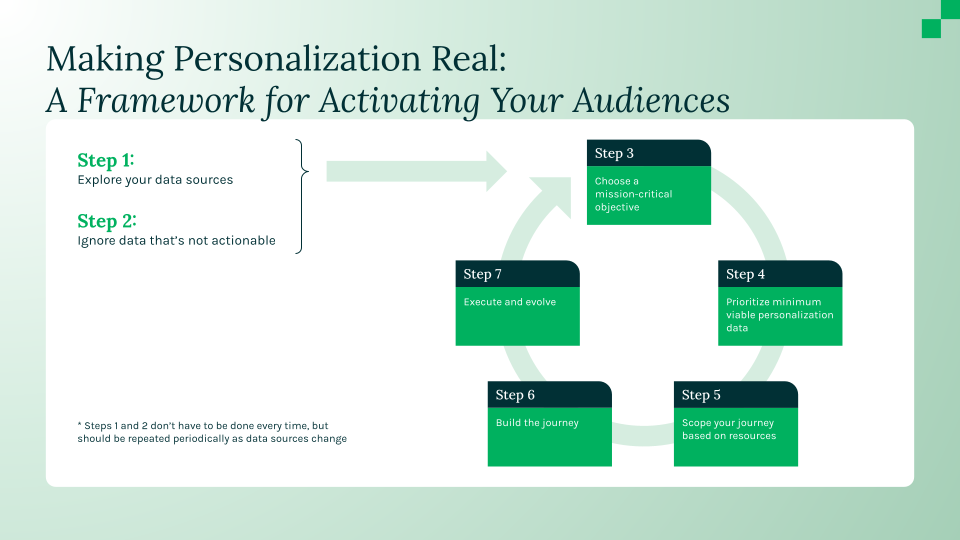
Steps 1 and 2: explore your data sources, then ignore data that's not actionable
Step one is to explore your data sources, and it is where you should spend most of your time. "Before you can think outside the box, you need to understand the box itself." List every system you need to audit, such as your customer relationship management (CRM) system, your analytics software and any third-party sources. Note what connects them, like a shared email address. Build a catalog of data fields and definitions. Also record what you don't have, so you can plan to get it.
The catalog has a second job: it gives business and technical teams one shared vocabulary. Gage has seen the same pattern in every role. Business teams leave a meeting unsure the technical team understood the request, and the technical team leaves unsure what the business team meant.
"Eight times out of 10, disagreements between business and technical teams just boil down to a communication issue. But even though the issue is simple, it can be crippling."

Step two is to ignore data that isn't actionable. A valuable trait that you hold for only 3% of customers, or that isn't available as a dimension in your marketing channels, won't scale. Keep a second list for fields that work as triggers, such as UTM parameters, custom events and return-visitor status. Knowing what you will use to shape the experience is half the job. Knowing how you will deliver it is the other half.
How AI-ready is your CMS, really?
Get a personalized AI-readiness score, a peer benchmark, your three biggest gaps and a 30/60/90-day action plan.
Step 3: choose a mission-critical objective
Step three is to choose a mission-critical objective. Tie each targeted experience to a single business objective. Teams that pick several measures of success end up with metrics, not key performance indicators (KPIs), and leave too much room for interpretation later. If you need more than one, Gage recommends one KPI that measures efficiency, such as conversion rate or attrition, and one KPI that measures effectiveness, such as leads driven or revenue. The first shows relative improvement from where you started. The second shows whether the effort matters at your scale. Collect benchmark data before you launch.
Steps 4 and 5: prioritize minimum viable personalization data, then scope your program
Step four is to prioritize minimum viable personalization data. Balance three questions: how many data points you truly need for relevance, how many experiences you can deliver that are uniquely relevant, and how data accuracy and completeness will shrink the audience. Then run the numbers. An audience of 10,000 sounds large. Apply a 20% click-through rate, 50% web engagement, a 2% application start rate and a 1% completion rate, and the focus may still be too narrow. Gage once had a campaign manager propose three personalized journeys, each with six stages across four channels, for personas of fewer than 100 users.
Step five is to scope your program based on your resources. Before you road-show a plan to stakeholders, talk to your development, creative and data teams about how many journeys and variants they can support, and over what period. Talk to compliance and legal teams about how each journey gets approved and documented. Plan for maintenance too. Creative can fatigue within weeks in high-frequency campaigns, so three personalized journeys can add up to a thousand creative assets a year, depending on refresh frequency. Document which journeys each persona receives. Targeting one persona with several journeys at once leads to confusion, overexposure and wasted budget. Be honest about capacity as well. Gage's own team runs testing and personalization alongside seven or more other specialties.
Steps 6 and 7: build the journey, then execute and evolve
Step six is to build the journey. Build for function, not just form. The user should feel no hesitation about why an offer appears. Gage's test is whether the offer meets a need the user already has. Use personal details like a name sparingly, because heavy use can feel disingenuous. Decide in advance when a campaign ends, whether that is a time limit, a frequency goal, a conversion or an opt-out. Map each journey from left to right by buyer stage, from awareness through retention and win-back, so leaders and analysts can see the flow and the likely drop-off points. Then check quality assurance (QA) on the creative, the user flow, the segment data and the tracking.
"Taking advantage of your offers should feel more like taking an off ramp on the highway to fulfill a need, like getting gas, using the restroom or picking up food, than being rammed off the road by a semi truck."
Step seven is to execute and evolve. After launch, confirm within 24 hours that everything works as designed. Update stakeholders on first results within three to seven days. Keep a change log with the date of each change, a plain description and the result you expect. It cuts the time you need to explain a shift in performance.
Why banks are moving from transactions to experiences
Our white paper on modern banking and digital experience
From framework to execution on Magnolia DXP
A framework only helps if your platform can carry it out. Gage's team delivers customized experiences on its website with Magnolia DXP, using component variants and page variants. UTM values trigger them, and those values identify audiences his team selected through deeper analysis in internal systems. The same audiences also reach people through media, email and offline journeys, within data privacy laws and regulations.
The most effective example he shared was also one of the simplest. His team attached a customized application offer to an email campaign that was already running. The offer reflects content the recipient has just seen, and a UTM parameter carries that signal to the website. It needed no complex system integration and no new tracking infrastructure. His advice: before you plan individual experiences, understand exactly what your personalization platform can do out of the box, and be realistic about how complex your needs are. Make sure stakeholders also understand the difference between personalization and A/B testing.
In Magnolia DXP, marketers define audiences by traits, such as home country or whether someone is a new or existing customer. They create content variants for individual components or for full pages. If your audiences span countries, our guide to international website personalization shows how this works across markets.
International website personalization: how it works
Learn how traits and content variants help you personalize for audiences across markets.
Prove the lift with a baseline
Gage puts benchmarking at the center of measurement. Use historical data to learn your starting point and any trends that could cloud the result. Then watch for a statistically significant change in trend after launch, within the time frame your sales cycle suggests. Keep other factors as constant as you can. When you need to choose between alternatives, run a test of non-personalized against personalized experiences.
"Benchmarking is your key to measuring incrementality. Once you know what you should expect without personalization, watch the trend with personalization."
Put privacy and consent first
For banks, this comes before every step. Gage is direct about it: "privacy, security, and consent have to come first. Those are your nonnegotiables."
Work with compliance and legal teams to secure approvals before you execute, and minimize your reliance on personally identifiable information (PII). He suggests making the offer itself personal enough that no name is needed. Good personalization should feel like a great birthday gift. It should never leave the recipient wondering whether you read a diary.
"My advice is to make the offer or experience so viscerally personal that you don't have to say 'Hi, John Smith.' Good personalization should make the recipient say, 'Oh, wow. They know me so well.'"
Start with less data and a clear goal
Personalization works when relevance, scale and governance pull in the same direction. Less data, chosen on purpose, gives you larger audiences, simpler rules and fewer compliance questions. A clear objective and an honest scope keep the program running after the first campaign.
Magnolia DXP gives marketers one platform to build audience-specific experiences without writing code, while IT keeps control. Banks and other regulated teams also need to know the platform itself is built for regulated work. Our security posture: ISO 27001:2022 and ENS (High) certified and SOC 2 Type II attested, GDPR, DORA readiness.
Guided Product Tour
Create digital experiences that resonate with your target audience without touching any code.
Too much data? A practical personalization framework
Key insights
-
More data does not make personalization easier. Every extra data point you target on shrinks the audience, adds compliance work and raises the risk of an experience that feels intrusive.
-
Gage Talbert, Vice President of Digital Marketing at Frost Bank, advises building experiences for functionally identifiable persona groups, not individuals, and checking that each group is large enough to matter.
-
Start from one business objective and the minimum viable data that serves it. Then size the creative, data and compliance work before you promise results.
-
Simple triggers often beat complex integrations. Frost Bank personalizes its website with page and component variants triggered by Urchin Tracking Module (UTM) values.
Why more data makes personalization harder
It can feel intrusive. Gage described mentioning a protein bar brand at a party and finding a free sample of the exact flavor on his porch the next morning. "It was helpful. It was highly relevant, but it was also very creepy, and it definitely lost that company my business." He is not alone: Attentive's 2026 survey of 1,050 consumers in the US, UK and Australia found that 46% of shoppers are concerned about data security.
It exposes weak data. Gage once received a text about the lapsed insurance on his "2016 Honda Accord," addressed to someone named Dave. He has never owned that car, and his name isn't Dave. In his words, "the more that they tried to personalize it, the more that they actually proved they didn't actually know me or my needs."
It adds compliance risk. The more data you customize on, the more governance resources you need to stay inside privacy rules.
It fragments the customer journey. Even when AI helps streamline production, Gage points out, hyper-personalization splits your audience into many separate journeys, and that makes consistently great experiences harder to deliver.
Banking personalization and the reality of customer AI demand
A Gartner® report on the technical and data gaps banks should close now to improve digital experience.
Read the reportA seven-step framework for personalization that scales
Steps 1 and 2: explore your data sources, then ignore data that's not actionable
"Eight times out of 10, disagreements between business and technical teams just boil down to a communication issue. But even though the issue is simple, it can be crippling."
How AI-ready is your CMS, really?
Get a personalized AI-readiness score, a peer benchmark, your three biggest gaps and a 30/60/90-day action plan.
Take the free CMS auditStep 3: choose a mission-critical objective
Step three is to choose a mission-critical objective. Tie each targeted experience to a single business objective. Teams that pick several measures of success end up with metrics, not key performance indicators (KPIs), and leave too much room for interpretation later. If you need more than one, Gage recommends one KPI that measures efficiency, such as conversion rate or attrition, and one KPI that measures effectiveness, such as leads driven or revenue. The first shows relative improvement from where you started. The second shows whether the effort matters at your scale. Collect benchmark data before you launch.
Steps 4 and 5: prioritize minimum viable personalization data, then scope your program
Step four is to prioritize minimum viable personalization data. Balance three questions: how many data points you truly need for relevance, how many experiences you can deliver that are uniquely relevant, and how data accuracy and completeness will shrink the audience. Then run the numbers. An audience of 10,000 sounds large. Apply a 20% click-through rate, 50% web engagement, a 2% application start rate and a 1% completion rate, and the focus may still be too narrow. Gage once had a campaign manager propose three personalized journeys, each with six stages across four channels, for personas of fewer than 100 users.
Step five is to scope your program based on your resources. Before you road-show a plan to stakeholders, talk to your development, creative and data teams about how many journeys and variants they can support, and over what period. Talk to compliance and legal teams about how each journey gets approved and documented. Plan for maintenance too. Creative can fatigue within weeks in high-frequency campaigns, so three personalized journeys can add up to a thousand creative assets a year, depending on refresh frequency. Document which journeys each persona receives. Targeting one persona with several journeys at once leads to confusion, overexposure and wasted budget. Be honest about capacity as well. Gage's own team runs testing and personalization alongside seven or more other specialties.
Steps 6 and 7: build the journey, then execute and evolve
Step six is to build the journey. Build for function, not just form. The user should feel no hesitation about why an offer appears. Gage's test is whether the offer meets a need the user already has. Use personal details like a name sparingly, because heavy use can feel disingenuous. Decide in advance when a campaign ends, whether that is a time limit, a frequency goal, a conversion or an opt-out. Map each journey from left to right by buyer stage, from awareness through retention and win-back, so leaders and analysts can see the flow and the likely drop-off points. Then check quality assurance (QA) on the creative, the user flow, the segment data and the tracking.
"Taking advantage of your offers should feel more like taking an off ramp on the highway to fulfill a need, like getting gas, using the restroom or picking up food, than being rammed off the road by a semi truck."
Step seven is to execute and evolve. After launch, confirm within 24 hours that everything works as designed. Update stakeholders on first results within three to seven days. Keep a change log with the date of each change, a plain description and the result you expect. It cuts the time you need to explain a shift in performance.
Why banks are moving from transactions to experiences
Our white paper on modern banking and digital experience
Read the white paperFrom framework to execution on Magnolia DXP
A framework only helps if your platform can carry it out. Gage's team delivers customized experiences on its website with Magnolia DXP, using component variants and page variants. UTM values trigger them, and those values identify audiences his team selected through deeper analysis in internal systems. The same audiences also reach people through media, email and offline journeys, within data privacy laws and regulations.
The most effective example he shared was also one of the simplest. His team attached a customized application offer to an email campaign that was already running. The offer reflects content the recipient has just seen, and a UTM parameter carries that signal to the website. It needed no complex system integration and no new tracking infrastructure. His advice: before you plan individual experiences, understand exactly what your personalization platform can do out of the box, and be realistic about how complex your needs are. Make sure stakeholders also understand the difference between personalization and A/B testing.
In Magnolia DXP, marketers define audiences by traits, such as home country or whether someone is a new or existing customer. They create content variants for individual components or for full pages. If your audiences span countries, our guide to international website personalization shows how this works across markets.
International website personalization: how it works
Learn how traits and content variants help you personalize for audiences across markets.
Read the BlogProve the lift with a baseline
Gage puts benchmarking at the center of measurement. Use historical data to learn your starting point and any trends that could cloud the result. Then watch for a statistically significant change in trend after launch, within the time frame your sales cycle suggests. Keep other factors as constant as you can. When you need to choose between alternatives, run a test of non-personalized against personalized experiences.
"Benchmarking is your key to measuring incrementality. Once you know what you should expect without personalization, watch the trend with personalization."
Put privacy and consent first
For banks, this comes before every step. Gage is direct about it: "privacy, security, and consent have to come first. Those are your nonnegotiables."
Work with compliance and legal teams to secure approvals before you execute, and minimize your reliance on personally identifiable information (PII). He suggests making the offer itself personal enough that no name is needed. Good personalization should feel like a great birthday gift. It should never leave the recipient wondering whether you read a diary.
"My advice is to make the offer or experience so viscerally personal that you don't have to say 'Hi, John Smith.' Good personalization should make the recipient say, 'Oh, wow. They know me so well.'"
Start with less data and a clear goal
Personalization works when relevance, scale and governance pull in the same direction. Less data, chosen on purpose, gives you larger audiences, simpler rules and fewer compliance questions. A clear objective and an honest scope keep the program running after the first campaign.
Magnolia DXP gives marketers one platform to build audience-specific experiences without writing code, while IT keeps control. Banks and other regulated teams also need to know the platform itself is built for regulated work. Our security posture: ISO 27001:2022 and ENS (High) certified and SOC 2 Type II attested, GDPR, DORA readiness.
Guided Product Tour
Create digital experiences that resonate with your target audience without touching any code.
Take the tour